Showing posts with label maple sap. Show all posts

Saturday, March 7, 2015

Getting Ready....

It's March 6th.....And, no sap, yet....We've been completely out of our own stock for over a month now.  Oy, Vey!  


We've had a challenging winter!  Well, actually, just a challenging February, really.   

Record-breaking frigid temperatures and record-breaking snowfall, according to all the meteorologists. 

However, the week ahead shows much promise, with predicted highs in the 40's, and lows in the 20's - perfect conditions to wake up the trees and begin collecting that sweet sap!


 The greatest challenge at the moment is actually getting to our trees to drill and tap them - there's easily 3 feet of snow out there!!  We began working on preparations earlier this week, but today and tomorrow we'll be busy little beavers. 


We are not working alone this year, however, because we've connected with another producer who lives about 9 miles east of us, right on Otisco Lake, the next "little finger" lake to the right of Skaneateles Lake on the map.  


She has fantastic equipment, knowledge to share, and a desire to educate the next generation of producers; we have young, strong "manpower", 500+ trees prepped, and a desire to learn - a perfect match!  More about that, and lots of pictures to come!
 

 Also, exciting - our little on-line store will be ready for purchases in April, thanks to our devoted friend, Josh!  But, I am still happy to hand-deliver syrup to my friends and family whenever possible, and folks are always welcome to stop by our home.   
And, this year, we plan to have not only maple syrup for sale, but also maple cream - a luxurious spread on toast, crackers, scones and more!


Friday, March 7, 2014

Organic Maple Syrup? What's up with that?

Over the past few months, Don and I have done tons of research, visited and spoken with a variety of people involved in the maple syrup industry, and checked out numerous producers' websites from all over northern North America.  I have even been checking out maple syrup in farm stores, gift shops and grocery stores, carefully examining the containers and labels, occasionally buying a sample for....analyzing, shall we say.  One might think we've got an unhealthy obsession with this sweet, beautiful, sticky, tasty "gift" of the maple tree. (Most sugarmakers do!)  Like I explained in a past post:  Nothing beats learning by immersion!


Often, I encounter the word "pure" on maple syrup labels, but, lately, I have been noticing the labels with the word "organic" on them.  What?  "How can maple syrup be anything but?" I questioned. The bottles and jars with the word "organic" are noticeably more expensive to me, so I have not purchased any, being a cost-conscious mom working within a modest grocery budget.  But, I am also a health-conscious mom.  So, I decided to do some research into this, both as a mom and a new maple syrup producer, so I can educate all of us on this matter.

In my opinion, people can take the whole "organic" thing way too far.  It has become an almost-spiritual matter for some folks - like eating all organic products somehow makes them more pure; better than the average person who still buys food products without that little green emblem on it. Like the rest of us are obviously uneducated neanderthals - makes me chuckle!  An all organic diet does not automatically equate to good health.  Cheese curls, even organic ones, still do not turn into carrots on the way down!  I believe moderation, prudence and wisdom are so important in diet and nutrition choices.  Educate (yourself) and evaluate!

So, what IS the difference when it comes to maple syrup?  I have found several articles and blog posts about this topic.  Of course, the syrup producers who have jumped through all the hoops and paid good money for their official government certification will defend it as the ONLY way to ensure you are getting totally "untainted" syrup. "Tainted by what?" I wondered.
 

Of all the producers we've met so far, no one fertilizes or sprays.... the forest - How ridiculous!  I guess it is possible that a few trees may be close to farm ground that is sprayed, but the chances of those chemicals affecting the trees, whose roots are very deep, is slim.  We are talking about native trees that are usually 30 yrs. old ...or older when tapped.  We're not talking about corn or wheat or produce- products grown in a mono-culture, one species of plant in an area that is largely dependent on human management to grow and flourish.  Those trees have been living off of their own sap for years, amongst a wide variety of other plant species. This aids to protect them against disease, bad molds, etc.  So long as we selectively remove overgrowth, they don't need us for much.  And, we only extract about 10% of the sap they actually produce in a year.

Many years ago, before folks knew any better, formaldehyde was used to clean the taps between seasons, but that practice died long ago.  Today, we use alcohol or hot water.


Some producers use one drop of canola or safflower oil per 80 gallons of sap to "defoam" the boiling sap. Apparently, the organic guys must use organic oil for this.

The organic producers have strict rules regarding the number of taps per tree based on its diameter.  However, all conscientious sugarmakers follow these guidelines for the health of their sugarbush.  I'm sure there are some irresponsible folks out there, but they can't stay in business very long with damaged trees.

I also learned that the organic producers must hand over their detailed records for scrutiny by the certifying agency.  All producers of any quality, however, keep detailed records of each season.


So, is "certified organic" maple syrup really any different than, say, what we are making this year? Or, what I have bought at the local farmer's market? Not really.  Is it worth the extra cost to buy it for my family's health?  Should we pay for the certification ourselves?  I would have to say.....NO. But, you need to make the decision for your own family.

However, I will stress that buying locally, or at least buying directly from a producer's website, is the best way to go.  I encourage you to visit your local sugarmaker.  If you buy syrup from a farm store or farmer's market research the producer, check out their website.  I guarantee you'll get a better product there than you will from the grocery store, though it may cost a little bit more (maybe, not). Most sugarmakers keep their best quality syrup for direct sales, as well as their own families!


These 2 articles sum it up fairly well.  The first is an article by Richard Bernstein published in the New York Times entitled "Is Organic Maple Syrup a Step In The Right Direction?"(www.nytimes.com ). And the second is a blog post entitled "Should we buy organic maple syrup?" by Kimi Harris ( http://www.thenourishinggourmet.com )

I encourage you, as much as possible,  Buy Local,  Buy direct!  Support the farmers and artisans in your community, Friends.


Monday, March 3, 2014

The Implications of "Keep Moving Forward"

We are an experiential, experimental, learn-as-we-go kind of family.  My husband is quite the risk-taker and does not fear failure, but rather takes it in stride and learns from it.  He would have enjoyed the company of guys like Walt Disney, Thomas Edison, Ben Franklin, and other such visionaries of the past. He lives by the motto from the Disney movie, Meet the Robinsons:  "Keep Moving Forward"!

So, as he researched this "maple syrup" idea of our son's, going small and simple wasn't even a consideration.

I said, "Let's just tap about 20 trees this year, for ourselves, to see what it's like.  And, we'll plan some field trips to maple producers this maple season."

"Nah.  Why waste our resources?  We've got a thousand maple trees out back, so let's just do it.... for real!," was Don's response, with that excited, challenge-seeking glint in his eyes.  ('Tis the story of my life!!)

For the sake of our children's learning, and for folks who want "educational tours" of our farm, my husband set up 3 different sap collection methods:


1.  bucket collection - both plastic and metal (8 trees, for now)                               


2.  high-vac gravity-flow collection (about 50 trees)  
      *note the blue tubing


 And...........


3.  vacuum pump system (300+ trees)
 * an elaborate maze of blue and black tubing connected to a pump which empties into a large tank


First, Don attempted to build a "releaser" for the vacuum pump system, himself, but after much trial and error, and many learning opportunities for him and our sons, they discovered that the materials, time and effort to build it correctly, would cost almost as much as buying the completed, brand new releaser from a local maple equipment dealer.  So, last weekend, he, Will, and Nate made the 3-hour, round-trip journey to make the purchase.


You can't actually suck sap from a tree, as the term "vacuum" implies.  However, with a vacuum pump system, you can significantly lower the air pressure outside of the trees, inducing the sap to flow more freely.  This can nearly double the amount of sap you will collect from your trees!

Once in place, he fired it up, and much to our delight, we added about 80+ gallons of sap to our tank in just 2 hours!  I am so glad for our little "dress rehearsal" last weekend, because now we know we'll get the maximum productivity out of the majority of our trees when it warms up for real!

It is so cool when the releaser dumps a barrel-full of sap into the tank!  The first time it released, our whole family cheered.  Here's a brief video:


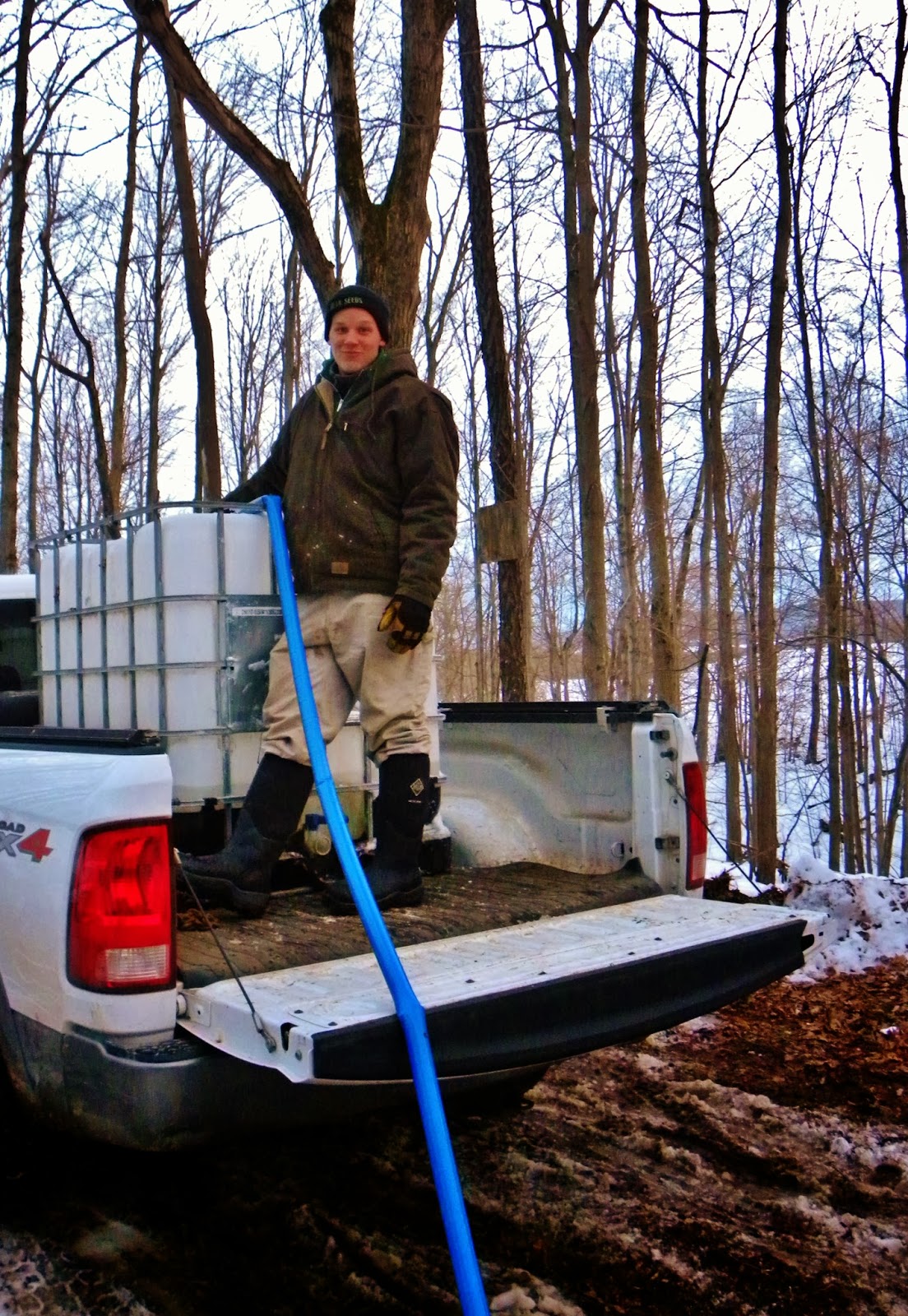
Once the tank is holding around 200 gallons, we pump it into a storage tote and transport it to the evaporator located in our barn...


For the record, Don (and the kids, whenever possible) have visited and spoken with several veteran maple producers in New York, Vermont and Pennsylvania over the past 4 months - some small producers of less than 200 taps, some with 80,000 taps!

Do we have the most efficient and sophisticated syrup collection and production system?  Nope.  But, what we have we've acquired without debt, Praise God! 

So, over the next few years we'll upgrade and streamline our maple operation as finances allow. Don thrives on finding more efficient ways to do things, and that gives him and our sons many great learning opportunities.  As homeschoolers, we love that part! I'll be sure to share what we're doing as we grow.  


We watch the weather carefully these days.  Looks like the next warm up will be around March 12th. Hopefully, we'll get a good, long sap run next time!  We're ready for it.
We hope to have our product page ready by early-May, so bookmark our website, Friends!


Tuesday, February 25, 2014

Journey of a Drop of Sap (part 2)

Now, let me see.....Where were we?  
That's right!  The "refining fire".....


This is where your "water weight" is being removed......mostly.


Our evaporator holds about 60 gallons of sap at a time.  When running "full steam" we can make about 2 and half gallons of syrup per hour.  We haven't had the opportunity to do that yet, though!


The way in which we have things set up at this time, you would go from here into a 55-gallon drum or......


...be finished off in a large, square metal pan or large pot.  You are heated up to about 218 degrees, give or take a few tenths depending on elevation and barometric pressure....(you're not quite there, yet).                


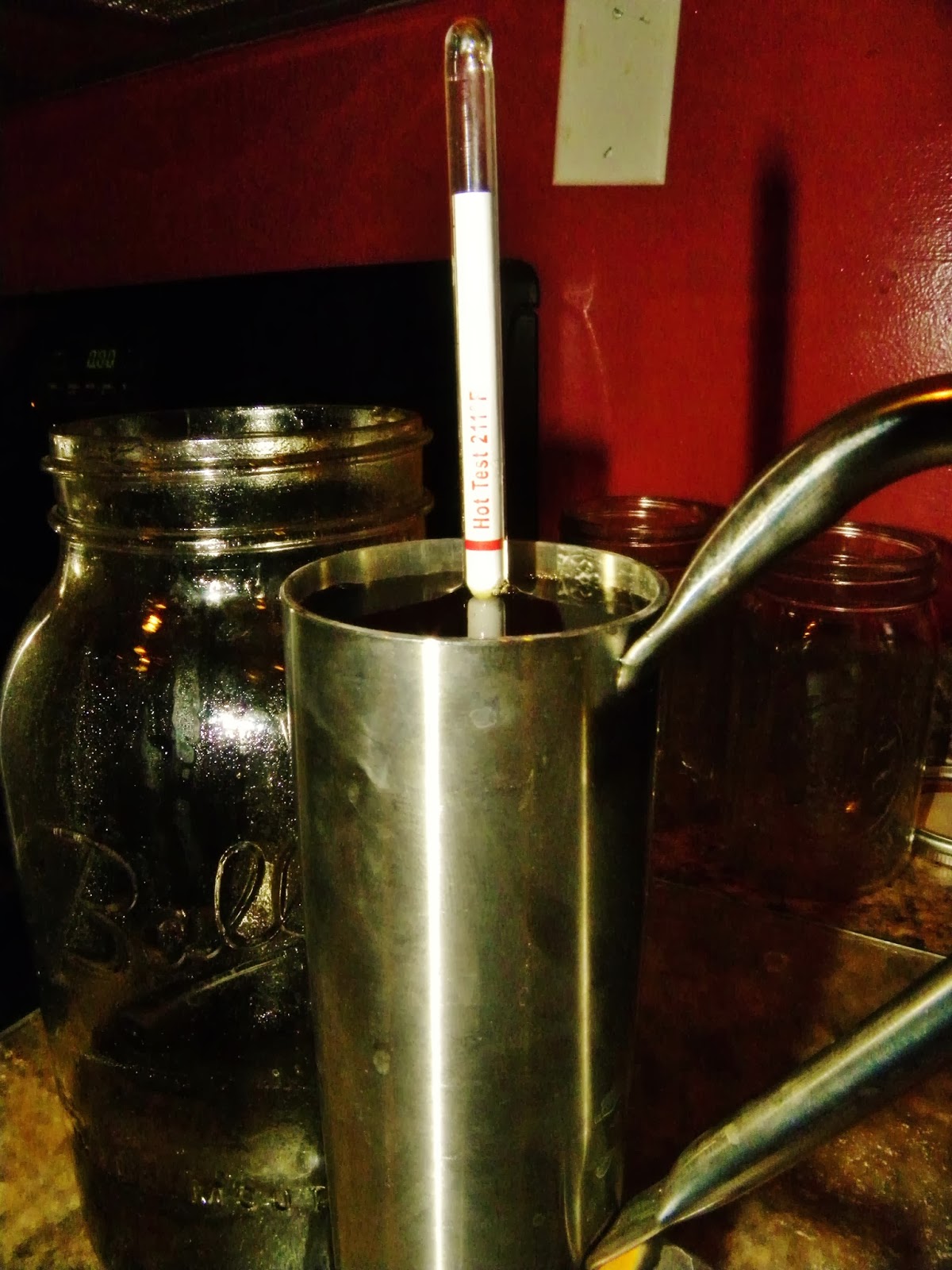
As your temperature rises, you are getting thicker and darker.  Your next stop is the hydrometer.  This is how we know, officially, that you are syrup...


Once you've reached the correct density, 66 degrees Brix, you'll slide from the pan or pot through a filter which removes most of your mineral sediment.  From here you are given a grade and color. (For this batch, it is grade A dark amber, my favorite!)


And, now, for the best part....................


Yes, your journey ends here

Each maple producer's syrup will have a slightly different taste.  In fact, each year the syrup will have a unique flavor, depending upon the weather conditions and such.  Ours has a rich "nutty" flavor this year.  Mmmm.....


Check in later this week for works from our poet, Grace!